Project Management in 2026: Agile vs. Scrum for Career Growth
Advertisements

Understanding the nuances of Agile and Scrum in 2026 is pivotal for project managers aiming for significant career advancement, as each methodology offers distinct pathways for skill development and leadership opportunities.
The landscape of project management is constantly evolving, and by 2026, mastering adaptive methodologies like Agile and Scrum is no longer optional but essential for professional growth. This article delves into how a solid grasp of agile scrum career paths can elevate your standing in the competitive job market, offering a detailed comparison to help you strategize your next career move.
The Evolution of Project Management in 2026
Project management in 2026 is characterized by rapid technological advancements, increasing global collaboration, and an unprecedented demand for flexibility. Traditional waterfall approaches, while still relevant in some niche areas, are largely being superseded by iterative and incremental methodologies that can adapt quickly to changing requirements and market demands. This shift emphasizes continuous delivery, customer feedback, and empowered teams.
The modern project manager is not just a taskmaster but a facilitator, a coach, and a strategic partner. They must possess a blend of technical acumen, leadership skills, and an understanding of human dynamics. The emphasis is on value delivery, not just project completion, making the choice of methodology critical for success and career trajectory.
Key Drivers of Change
- Digital Transformation: The ongoing digital revolution demands project management frameworks that can support rapid software development and continuous integration.
- Remote and Hybrid Work: Distributed teams require methodologies that foster communication, transparency, and self-organization regardless of physical location.
- Customer-Centricity: An increased focus on user experience and customer satisfaction necessitates iterative development cycles and frequent feedback loops.
Understanding these drivers is crucial for any professional looking to thrive in project management. The ability to navigate these complexities using appropriate methodologies will distinguish top performers. This foundational understanding sets the stage for a deeper dive into Agile and Scrum, highlighting their relevance for your future career.
Understanding Agile Methodologies: A Broad Overview
Agile is not a single methodology but a philosophy, a set of principles outlined in the Agile Manifesto, emphasizing iterative development, collaboration, and responsiveness to change. It’s an umbrella term encompassing various frameworks, with Scrum being the most popular. At its core, Agile promotes adaptive planning, evolutionary development, early delivery, and continuous improvement.
In 2026, Agile principles are embedded across various industries, from software development to marketing and even HR. Its emphasis on breaking down large projects into smaller, manageable chunks allows teams to deliver value incrementally, gather feedback, and adjust course as needed. This iterative nature inherently reduces risk and increases the likelihood of delivering a product that truly meets customer needs.
Core Agile Principles
- Individuals and Interactions: Valuing people over processes and tools.
- Working Software: Prioritizing functional products over comprehensive documentation.
- Customer Collaboration: Engaging with customers throughout the development cycle.
- Responding to Change: Adapting to new requirements rather than rigidly following a plan.
Agile methodologies foster environments where teams are self-organizing and cross-functional, leading to higher morale and increased productivity. For career advancement, demonstrating a deep understanding of Agile principles and their application across different contexts is highly valued. It signals adaptability and a focus on delivering tangible results.
Deep Dive into Scrum: The Most Popular Agile Framework
Scrum is a lightweight, iterative, and incremental Agile framework for managing complex projects, particularly in software development. It’s often the first framework people learn when entering the Agile world due to its structured yet flexible approach. Scrum operates through short cycles called ‘sprints,’ typically lasting one to four weeks, during which a ‘potentially shippable increment’ of work is produced.
The framework defines specific roles, events, and artifacts designed to facilitate transparent communication, continuous inspection, and adaptation. Key roles include the Product Owner, who defines and prioritizes the product backlog; the Scrum Master, who facilitates the Scrum process and removes impediments; and the Development Team, who builds the product increment. These roles ensure accountability and efficient workflow.
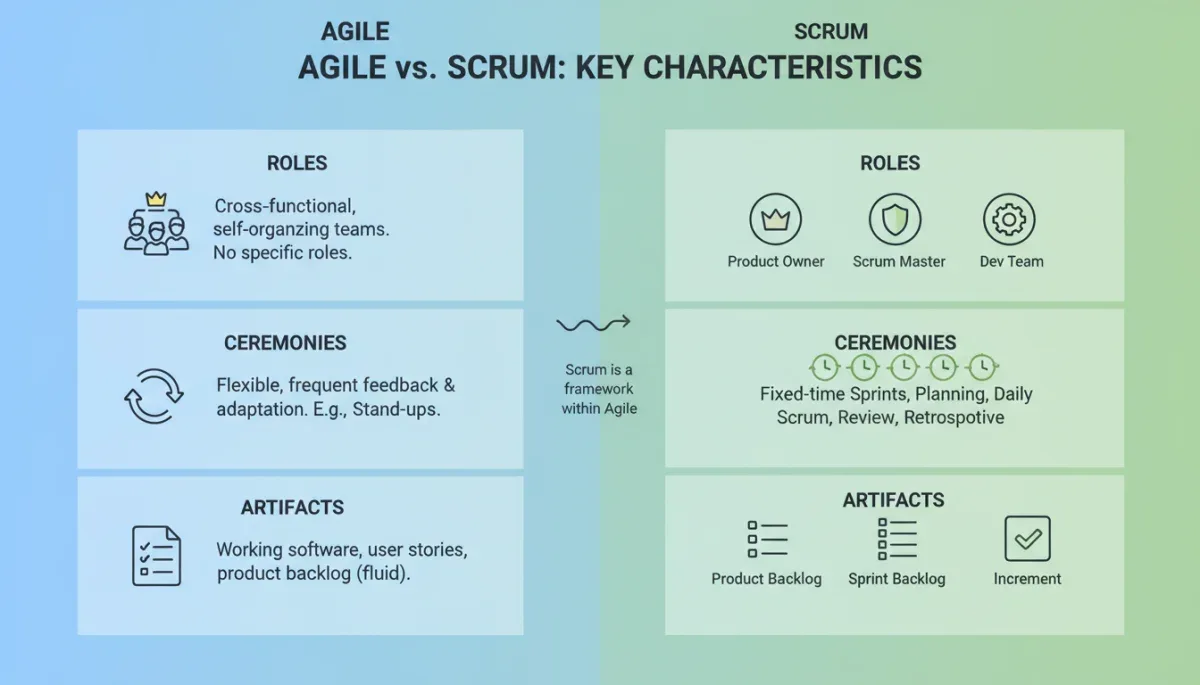
Scrum’s prescriptive nature, with its daily stand-ups, sprint reviews, and retrospectives, provides a rhythm that helps teams stay focused and continuously improve their processes. This structured approach, combined with Agile’s flexibility, makes Scrum a powerful tool for delivering complex projects efficiently. Professionals proficient in Scrum are highly sought after in 2026, as they can drive predictable delivery in dynamic environments.
Agile vs. Scrum: Key Differences and Similarities
While Scrum is a specific implementation of Agile, it’s important to differentiate between the two. Agile is the overarching philosophy; Scrum is a framework within that philosophy. All Scrum projects are Agile, but not all Agile projects are Scrum. This distinction is fundamental for understanding their application and career implications.
Agile provides a set of guiding principles, allowing for a wide range of interpretations and adaptations. Other Agile frameworks include Kanban, Lean, and Extreme Programming (XP), each with its unique practices. Scrum, on the other hand, offers a more defined structure with specific roles, events, and artifacts that teams must adhere to. This makes Scrum easier to implement initially but requires discipline to maintain.
Distinguishing Characteristics
- Scope: Agile is a broad mindset; Scrum is a detailed framework for managing projects.
- Flexibility: Agile offers more flexibility in implementation; Scrum has defined rules.
- Roles: Agile has general roles (e.g., project manager); Scrum has specific roles (Product Owner, Scrum Master, Development Team).
- Ceremonies: Agile doesn’t mandate specific ceremonies; Scrum has daily stand-ups, sprint planning, reviews, and retrospectives.
Both methodologies share common ground in their commitment to iterative development, customer collaboration, and continuous improvement. The choice between a pure Agile approach or a specific framework like Scrum often depends on the project’s complexity, team size, and organizational culture. For career advancement, understanding when and why to apply each is a significant asset.
Career Advancement with Agile and Scrum in 2026
For professionals eyeing career advancement in 2026, proficiency in both Agile principles and Scrum practices is a significant differentiator. Employers are actively seeking individuals who can not only manage projects but also lead teams through complex, fast-paced environments using these modern methodologies. Certifications in Scrum (e.g., Certified ScrumMaster, Certified Product Owner) are particularly valuable, signaling expertise and commitment.
Beyond certifications, practical experience in applying Agile and Scrum within diverse projects is crucial. This includes leading sprint planning, facilitating daily stand-ups, managing product backlogs, and conducting retrospectives. The ability to articulate how these practices contribute to business value and team efficiency will set you apart. Furthermore, a deep understanding of scaling Agile frameworks, such as SAFe or LeSS, can open doors to more senior leadership roles in larger organizations.
Pathways for Growth
- Scrum Master: Focus on facilitating the Scrum process, coaching the team, and removing impediments.
- Product Owner: Drive product vision, manage the product backlog, and ensure value delivery.
- Agile Coach: Guide multiple teams or an entire organization in adopting Agile principles and practices.
- Release Train Engineer (RTE): In scaled Agile environments, coordinate multiple Agile teams.
Developing strong soft skills, such as communication, conflict resolution, and leadership, is equally important. Agile and Scrum thrive on collaboration and transparency, making these interpersonal abilities indispensable. Investing in continuous learning and adapting to new trends within these methodologies will ensure sustained career growth.
Choosing the Right Methodology for Your Projects and Career
Deciding between a pure Agile approach or a specific framework like Scrum depends on several factors related to the project, team, and organizational context. There isn’t a one-size-fits-all answer, and often, a hybrid approach or a blend of practices from different frameworks proves most effective. The key is to understand the strengths and weaknesses of each and apply them judiciously.
For projects with well-defined requirements that are unlikely to change, a more traditional approach might suffice. However, for complex, innovative projects with evolving requirements, Agile or Scrum are almost always the superior choice. Consider the team’s familiarity with the methodologies, the level of customer involvement, and the organizational culture’s readiness for change. A successful project manager in 2026 is adept at assessing these factors and recommending the most suitable methodology.
Factors to Consider
- Project Complexity: Highly complex projects benefit more from iterative and adaptive frameworks.
- Requirement Volatility: Projects with frequently changing requirements are ideal for Agile/Scrum.
- Team Autonomy: Self-organizing teams thrive in Agile and Scrum environments.
- Organizational Culture: A culture that embraces change and collaboration is essential.
From a career perspective, gaining experience in both broad Agile principles and specific Scrum implementations makes you a versatile and highly valuable asset. This versatility demonstrates your ability to adapt to different project needs and lead various types of teams, significantly boosting your career prospects.
Future Trends and Continuous Learning in Agile/Scrum
The world of Agile and Scrum is not static; it continues to evolve with new practices, tools, and scaling frameworks emerging regularly. Staying ahead in 2026 means committing to continuous learning and adaptation. This includes exploring advanced topics like DevOps integration, AI in project management, and further developments in scaled Agile frameworks. The integration of AI, for instance, is already beginning to automate routine tasks, allowing project managers to focus on strategic decision-making and team coaching.
Furthermore, the emphasis on empathy and emotional intelligence in leadership roles is growing within Agile and Scrum communities. As teams become more distributed and diverse, the ability to foster a positive, inclusive environment is paramount. Participation in Agile communities, attending conferences, and pursuing advanced certifications are excellent ways to stay current and expand your professional network.
Emerging Areas to Watch
- AI-Powered Project Management: Tools leveraging AI for predictive analytics, risk assessment, and task automation.
- DevOps Integration: Seamless integration of development and operations for faster, more reliable software delivery.
- Sustainable Agile: Applying Agile principles to promote environmental and social responsibility in project outcomes.
Embracing these future trends not only enhances your skill set but also positions you as a thought leader in the project management space. Continuous learning is the cornerstone of a successful and enduring career in Agile and Scrum, ensuring you remain relevant and indispensable in 2026 and beyond.
| Key Point | Brief Description |
|---|---|
| Agile Philosophy | An umbrella term emphasizing iterative development, collaboration, and adaptability to change. |
| Scrum Framework | A specific Agile framework with defined roles, events (sprints), and artifacts for complex projects. |
| Career Advancement | Proficiency in both Agile principles and Scrum practices is crucial for 2026 project management roles. |
| Continuous Learning | Staying updated with new trends like AI and DevOps in Agile/Scrum is vital for long-term success. |
Frequently Asked Questions About Agile and Scrum in 2026
What is the primary difference between Agile and Scrum?▼Agile is a broad philosophy emphasizing iterative development and adaptability. Scrum is a specific framework within Agile, providing defined roles, events like sprints, and artifacts for managing complex projects. All Scrum projects are Agile, but not all Agile projects use Scrum.
Which methodology is better for career advancement in 2026?▼Both are crucial. A strong understanding of Agile principles demonstrates adaptability, while proficiency in Scrum practices shows practical execution skills. Certifications and practical experience in both enhance career prospects significantly, opening doors to various specialized roles.
Are Agile and Scrum only for software development?▼While originating in software, Agile and Scrum principles are now widely applied across diverse industries. Many sectors, including marketing, product development, and even HR, leverage these methodologies to manage complex projects, foster collaboration, and deliver value incrementally.
What are the key roles in a Scrum team?▼The three core roles in Scrum are the Product Owner, responsible for the product backlog and vision; the Scrum Master, who facilitates the process and removes impediments; and the Development Team, a self-organizing group building the product increment.
How can I start learning Agile and Scrum for my career?▼Begin with introductory courses and read the Agile Manifesto and Scrum Guide. Consider pursuing recognized certifications like Certified ScrumMaster (CSM) or Professional Scrum Master (PSM). Gaining practical experience through projects is also vital for understanding real-world application.
Conclusion
The dynamic landscape of project management in 2026 underscores the critical importance of understanding and applying modern methodologies. Both Agile and Scrum offer robust frameworks for navigating complex projects, fostering innovation, and delivering continuous value. For professionals seeking career advancement, developing expertise in these areas is non-negotiable. By embracing continuous learning, acquiring relevant certifications, and honing practical skills, you can position yourself at the forefront of project management and unlock significant professional opportunities.