ROI of Professional Development: Justifying a $5K Training Investment
Advertisements

Justifying a $5,000 training investment for US career gains requires a clear understanding of its return on investment (ROI), encompassing increased salary, skill acquisition, and enhanced job security in a competitive market.
The ROI of Professional Development: Justify Your $5,000 Investment
In today’s rapidly evolving job market, the concept of continuous learning is no longer a luxury but a necessity. For many US professionals, investing in professional development ROI, such as a $5,000 training program, can seem like a significant financial commitment. This article explores how to thoroughly justify such an investment, demonstrating its tangible and intangible returns for your career.
Understanding the Investment Landscape in US Professional Development
The US job market is characterized by fierce competition and a constant demand for up-to-date skills. This environment makes professional development not just an option, but often a critical component for career progression. A $5,000 investment might appear substantial, yet when viewed through the lens of long-term career trajectory, it can be a pivotal decision.
Many professionals hesitate, weighing the immediate financial outlay against uncertain future gains. However, the landscape of professional growth has shifted. Employers increasingly value proactive individuals who invest in their own learning, recognizing that such commitment translates directly into enhanced productivity and innovation within their organizations. Understanding this dynamic is the first step in building a compelling case for your training.
The cost of inaction versus investment
Consider the potential costs of not investing in professional development. Stagnation in skills can lead to reduced marketability, missed promotion opportunities, and even job insecurity. In contrast, a well-chosen training program can open doors to new roles, higher salaries, and greater job satisfaction. It’s not merely about spending money; it’s about strategically allocating resources for future success.
- Lost earning potential due to outdated skills.
- Reduced competitiveness in the job market.
- Limited access to advanced career opportunities.
- Decreased job satisfaction from skill stagnation.
Ultimately, the investment in professional development is an investment in yourself, your capabilities, and your future earning power. When evaluated against the potential for career stagnation, the $5,000 becomes a strategic expenditure designed to propel you forward in your chosen field.
Quantifying the Financial Return: Salary Increases and Promotions
One of the most direct ways to justify a $5,000 training investment is by demonstrating its potential to lead to higher income. Many professional certifications and specialized training programs are directly correlated with significant salary bumps and faster promotion rates in the US. Researching industry benchmarks and salary guides can provide concrete data to support your case.
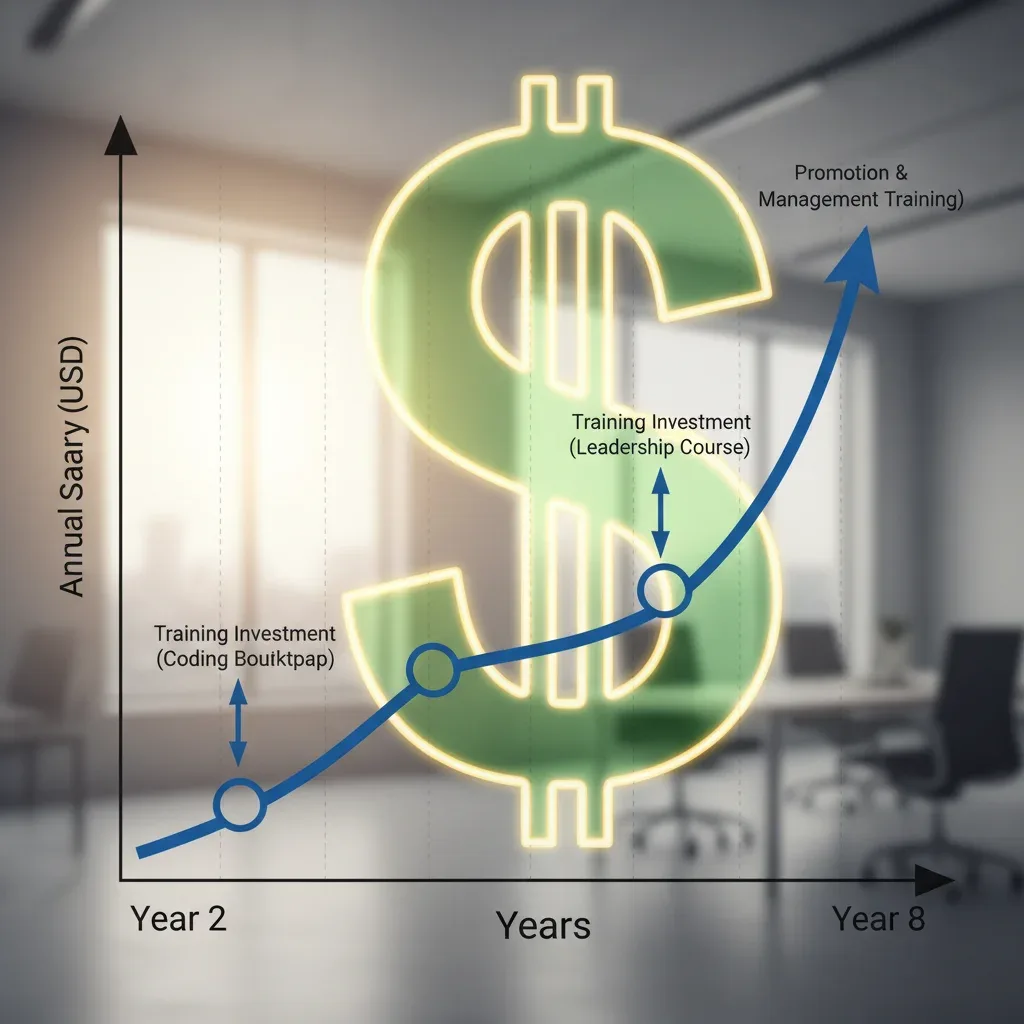
For instance, a project management certification or a specialized tech boot camp could increase your earning potential by 10-20% or more within a year or two. Over a decade, this translates into tens of thousands of dollars, making the initial $5,000 investment seem minor in comparison. It’s about projecting the future value of your enhanced skill set.
Calculating your potential salary boost
To calculate this, identify the average salary for your current role and the average salary for roles requiring the specific skills or certifications you plan to acquire. The difference represents your potential salary increase. Factor in the time it might take to achieve this increase post-training.
- Identify target roles and their average salaries.
- Estimate the time to achieve new qualifications.
- Project annual salary increase over 3-5 years.
- Compare total gains against the $5,000 investment.
A promotion often comes with a substantial salary increase and greater responsibilities. Advanced training can make you a more attractive candidate for internal promotions, showing your employer your commitment to growth and your enhanced capacity to take on higher-level tasks. This financial return is often the easiest to measure and present.
Enhancing Skill Sets and Marketability in the US Job Market
Beyond direct salary increases, professional development significantly enhances your skill set, making you more marketable and adaptable. In the dynamic US job market, employers are constantly seeking candidates with cutting-edge skills. A $5,000 training program can equip you with highly sought-after competencies that differentiate you from your peers.
Consider the rise of artificial intelligence, data analytics, or advanced digital marketing. Training in these areas can future-proof your career, ensuring you remain relevant and indispensable. This isn’t just about getting a new job; it’s about securing your professional longevity and opening doors to diverse opportunities that might not have been accessible before.
Identifying in-demand skills
Before committing to a program, research which skills are most in-demand in your industry and geographic region within the US. Platforms like LinkedIn, industry reports, and job boards can provide valuable insights. Aligning your training with these critical needs maximizes your return on investment.
The ability to acquire new skills quickly is a skill in itself. Demonstrating this capacity through a structured training program not only provides you with specific knowledge but also showcases your initiative and learning agility to potential employers. This soft skill is invaluable and contributes significantly to your overall marketability.
Career Advancement and Networking Opportunities
A $5,000 training investment can lead to significant career advancement, not only through skill acquisition but also through expanded professional networks. Many reputable training programs in the US attract high-caliber professionals and instructors, creating invaluable networking opportunities.
Connecting with peers, industry leaders, and potential mentors during a training program can open doors to collaborative projects, job referrals, and insights into unadvertised opportunities. These connections can be just as valuable, if not more so, than the technical skills learned, providing a long-term return on your investment in ways that are hard to quantify but profoundly impactful.
Building a robust professional network
Active participation in training programs, attending workshops, and engaging with instructors and fellow students are key to maximizing networking benefits. These interactions can lead to mentorships, partnerships, and a broader understanding of industry trends and challenges.
- Engage actively with instructors and peers.
- Participate in group projects and discussions.
- Attend program-related networking events.
- Follow up with valuable contacts post-training.
Furthermore, the reputation of the institution or certification body offering the training can significantly boost your credibility. Being associated with a highly respected program signals to employers that you possess a certain standard of knowledge and commitment, enhancing your professional standing and opening pathways to leadership roles.
Intangible Benefits: Confidence, Job Satisfaction, and Personal Growth
While financial returns are crucial, the intangible benefits of professional development are equally important for long-term career success and personal well-being. Investing $5,000 in your training can lead to increased confidence, higher job satisfaction, and significant personal growth, all of which contribute to a more fulfilling career in the US.
Acquiring new knowledge and mastering challenging skills can boost your self-esteem and empower you to take on more complex tasks. This renewed confidence can lead to better performance, greater visibility within your organization, and a more positive outlook on your career path. It’s an investment in your mental and emotional capital.
The ripple effect of increased confidence
When you feel more capable, you are more likely to seek out new challenges, contribute innovative ideas, and advocate for yourself. This proactive approach can create a positive feedback loop, leading to further opportunities and recognition. The initial investment pays dividends in your overall professional demeanor.
Job satisfaction often stems from feeling competent and valued. When you are continuously learning and applying new skills, your work becomes more engaging and less monotonous. This increased satisfaction can reduce burnout, improve work-life balance, and make your career journey more enjoyable and sustainable in the long run.
Strategies for Justifying the Investment to Your Employer
If you’re seeking company sponsorship for a $5,000 training program, a well-structured justification is essential. Employers are often willing to invest in their workforce if they can see a clear return for the organization. Frame your request around how the training will benefit the company, not just your personal career.
Highlight how your newly acquired skills will address specific company needs, improve team performance, or contribute to strategic objectives. Provide a clear outline of the program, its learning outcomes, and how these align with organizational goals. Presenting a clear business case can significantly increase your chances of approval.
Crafting a compelling business case
Prepare a proposal that includes the program details, cost breakdown, and a clear explanation of the benefits to the company. Quantify the potential impact where possible, such as improved efficiency, reduced errors, or increased revenue streams.
- Identify company problems the training will solve.
- Outline specific skills gained and their application.
- Estimate potential ROI for the organization (e.g., cost savings).
- Propose a plan for knowledge transfer to colleagues.
- Commit to a timeframe for applying new skills.
Emphasize your commitment to the company and how this investment will make you a more valuable asset. Be ready to discuss how you will balance training with your current responsibilities and how you plan to share your new knowledge with your team, fostering a culture of continuous learning within the organization.
Making the Most of Your $5,000 Training Investment
Once you’ve committed to a $5,000 professional development program, maximizing its value is paramount. It’s not enough to simply complete the training; active engagement and strategic application of what you learn are crucial for realizing the full return on your investment in your US career. Approach the program with a clear set of goals and a proactive mindset.
Actively participate in all aspects of the training, ask questions, and engage with instructors and peers. The more you put into the learning experience, the more you will get out of it. Consider how each module or lesson can be directly applied to your current role or future career aspirations. This practical focus ensures that the knowledge gained is not theoretical but actionable.
Applying new knowledge effectively
Immediately after completing the training, look for opportunities to implement your new skills. This could involve volunteering for new projects, offering to lead initiatives, or even redesigning current processes. The sooner you apply what you’ve learned, the stronger the retention and the quicker you’ll demonstrate its value.
- Set clear learning objectives before starting.
- Seek opportunities to apply new skills immediately.
- Track progress and measurable improvements.
- Share insights and knowledge with colleagues.
Additionally, document your achievements and the impact of your new skills. This can be invaluable for performance reviews, salary negotiations, and future job applications. By continuously reflecting on and articulating the benefits derived from your training, you reinforce its value and ensure that your $5,000 investment continues to pay dividends throughout your career.
| Key Aspect | Benefit of Training Investment |
|---|---|
| Financial Return | Potential for significant salary increases and faster promotions. |
| Skill Enhancement | Acquisition of in-demand skills, increasing marketability and adaptability. |
| Career Advancement | Expanded professional network and access to higher-level opportunities. |
| Intangible Benefits | Increased confidence, job satisfaction, and personal growth. |
Frequently Asked Questions About Professional Development ROI
How quickly can I see a return on a $5,000 training investment?▼The timeline for ROI varies significantly based on the training type and industry. Some specialized certifications can lead to salary increases within 6-12 months, while broader skill development might show returns over 1-3 years through promotions or new job opportunities. Consistent application of new skills accelerates the process.
What factors should I consider when choosing a training program?▼Consider the program’s relevance to your career goals and industry demands, the reputation of the institution, instructor expertise, and the practical applicability of the skills taught. Also, evaluate the program’s format (online, in-person) and its networking opportunities. Ensure it aligns with current US job market needs.
Is it better to invest in certifications or broader skill development?▼Both have merits. Certifications often provide a clear, recognized credential that can directly impact salary and promotion. Broader skill development builds a more adaptable foundation. The best choice depends on your immediate career goals versus long-term versatility. A blend often yields the best results for US professionals.
How can I convince my employer to pay for my training?▼Develop a clear business case highlighting how the training benefits the company. Focus on improved performance, problem-solving, and alignment with organizational goals. Quantify potential returns, such as increased efficiency or new revenue streams, and propose a plan to share knowledge with your team. Show commitment to their success.
What are the risks of not investing in professional development?▼The primary risks include skill obsolescence, reduced marketability, missed opportunities for promotion, and potential job stagnation. In a competitive US job market, failing to update skills can lead to decreased earning potential and make it harder to adapt to industry changes, ultimately hindering long-term career growth.
Conclusion
Justifying a $5,000 training investment for US career gains is a strategic endeavor that extends far beyond immediate costs. By meticulously analyzing potential financial returns, such as salary increases and promotions, alongside the invaluable benefits of enhanced skills, expanded networks, and boosted confidence, professionals can build a compelling case for their growth. This investment is not merely an expense; it is a calculated step towards securing a more prosperous, fulfilling, and future-proof career in a dynamic and competitive professional landscape.