Six Sigma Certification: Green Belt vs. Black Belt for 2026
Advertisements

Six Sigma Certification, whether Green Belt or Black Belt, offers distinct pathways for professionals seeking to master process improvement, with the ideal choice in 2026 depending on individual career aspirations and desired project leadership involvement.
Considering a Six Sigma Certification in 2026 is a strategic move for professionals aiming to excel in process improvement and quality management. This guide will help you navigate the crucial decision between Green Belt and Black Belt training, ensuring you select the path best suited for your career aspirations and the evolving demands of the modern workplace.
understanding six sigma: a foundation for excellence
Six Sigma is a data-driven methodology used to eliminate defects and improve processes within organizations. It’s not just a set of tools; it’s a philosophy that emphasizes continuous improvement and customer satisfaction. Understanding its core principles is the first step toward appreciating the value of its certifications.
The methodology employs a structured approach, typically following the DMAIC (Define, Measure, Analyze, Improve, Control) roadmap, to solve problems and optimize workflows. This systematic framework ensures that solutions are data-backed and sustainable, leading to significant cost savings and enhanced product or service quality. Embracing Six Sigma means fostering a culture of precision and efficiency.
the core tenets of six sigma
At its heart, Six Sigma is about achieving near-perfection. This means reducing process variation and identifying the root causes of defects. It’s a rigorous approach that requires a deep understanding of statistical analysis and project management.
- Customer Focus: All improvement efforts are centered on meeting and exceeding customer expectations.
- Process Orientation: Understanding and optimizing processes are key to achieving desired outcomes.
- Data-Driven Decisions: Statistical analysis guides every stage of problem-solving and improvement.
- Proactive Management: Emphasizes preventing defects rather than merely correcting them.
Ultimately, Six Sigma provides a universal language for quality improvement, applicable across various industries. Its principles are timeless, making certification a valuable asset for any professional seeking to drive operational excellence.
six sigma green belt: your entry into process improvement
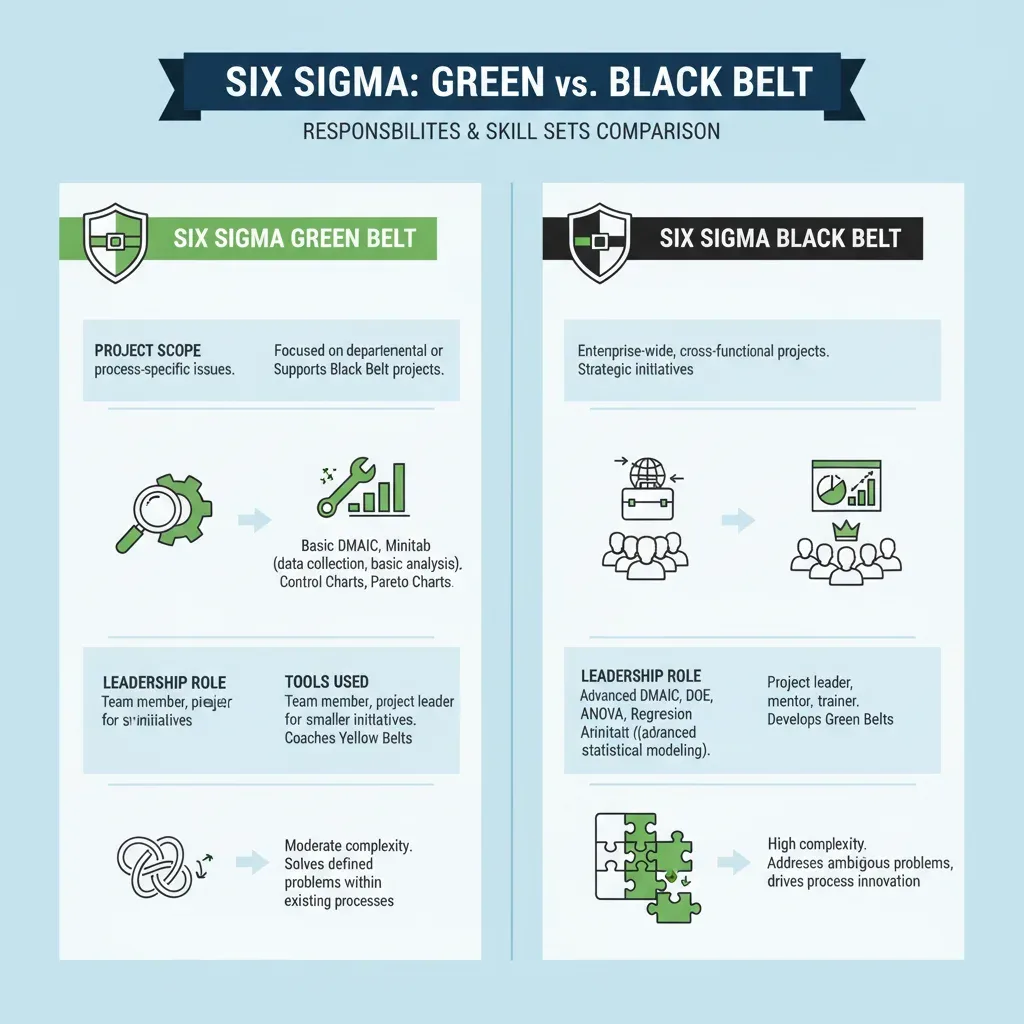
The Six Sigma Green Belt certification is often the entry point for professionals looking to contribute to quality improvement projects. Green Belts typically work under the guidance of Black Belts, leading smaller-scale projects or contributing to larger ones within their specific functional areas. This role is crucial for implementing change at the operational level.
Green Belts are equipped with a strong understanding of the DMAIC methodology and various Six Sigma tools. They are instrumental in data collection, analysis, and implementing solutions that drive efficiency and reduce waste. Their involvement ensures that improvement initiatives are effectively integrated into daily operations.
roles and responsibilities of a green belt
A Six Sigma Green Belt acts as a key player in the process improvement team. They are often responsible for leading minor improvement projects from conception to completion, or providing analytical support to more complex projects led by Black Belts. Their ability to translate data into actionable insights is highly valued.
- Project Leadership: Leading small-to-medium scale improvement projects within their department.
- Data Analysis: Collecting and analyzing data to identify process inefficiencies and root causes of defects.
- Team Collaboration: Working with cross-functional teams to implement solutions and monitor improvements.
- Training and Mentoring: Potentially training others on basic Six Sigma principles and tools.
For professionals seeking to develop their problem-solving skills and make a tangible impact on their organization’s efficiency, the Green Belt certification offers a robust foundation. It’s an excellent stepping stone for those aspiring to more advanced roles in quality management.
six sigma black belt: mastering advanced process optimization
The Six Sigma Black Belt certification signifies a master of the Six Sigma methodology, capable of leading complex, enterprise-wide improvement projects. Black Belts are typically full-time roles dedicated to driving significant organizational change and mentoring Green Belts. This level requires a deeper statistical understanding and strong leadership capabilities.
Black Belts are responsible for identifying strategic opportunities for improvement, developing project charters, and ensuring the successful execution of high-impact initiatives. They often work directly with senior management to align improvement efforts with broader business objectives, making them critical assets for organizational transformation.
key distinctions in black belt responsibilities
Unlike Green Belts, Black Belts operate at a more strategic level, tackling problems that often involve multiple departments or even entire business units. Their expertise extends beyond basic statistical tools to encompass advanced analytical techniques and change management strategies.
- Strategic Project Management: Leading large, complex, and cross-functional Six Sigma projects.
- Advanced Statistical Analysis: Utilizing sophisticated statistical software and techniques for deep data insights.
- Mentorship and Training: Coaching and guiding Green Belts and other team members in Six Sigma principles.
- Organizational Change Agent: Driving cultural shifts towards continuous improvement and data-driven decision-making.
The Black Belt certification is ideal for experienced professionals who aspire to leadership roles in quality and process improvement, equipped to tackle the most challenging operational issues and deliver substantial business results.
curriculum comparison: green belt vs. black belt training
The training curriculum for Six Sigma Green Belt and Black Belt certifications differs significantly in depth, scope, and statistical complexity. While both levels cover the DMAIC methodology, the Black Belt curriculum delves into more advanced analytical tools and leadership strategies, preparing individuals for a broader range of challenges.
Green Belt training focuses on foundational concepts, practical application of basic statistical tools, and project management skills for localized improvements. It provides a solid understanding of how to participate effectively in and lead smaller Six Sigma projects. The emphasis is on hands-on application within a defined scope.
what to expect in each program
The content covered in each program is tailored to the responsibilities of the respective belt level. Understanding these differences is crucial for selecting the appropriate certification path.
- Green Belt Curriculum:
- Introduction to Six Sigma and Lean principles.
- DMAIC roadmap overview and application.
- Basic statistical analysis, control charts, and process capability.
- Problem-solving tools like FMEA, Pareto charts, and cause-and-effect diagrams.
- Black Belt Curriculum:
- Advanced statistical methods, including hypothesis testing, ANOVA, and regression analysis.
- Design of Experiments (DOE) and advanced measurement systems analysis.
- Leadership, change management, and team facilitation.
- Strategic deployment of Six Sigma within an organization.
The Black Belt program builds upon the Green Belt foundation, offering a more extensive and intensive learning experience that prepares individuals for complex problem-solving and strategic leadership in quality improvement.
career impact: how each certification elevates your profile
Both Six Sigma Green Belt and Black Belt certifications significantly enhance a professional’s career prospects, but they do so in different ways. A Green Belt signals proficiency in process improvement, opening doors to roles focused on operational efficiency. A Black Belt, however, positions an individual as a leader in organizational change, capable of driving strategic initiatives and mentoring others.
For those early in their career or looking to specialize in a particular function, a Green Belt can provide a competitive edge, demonstrating a commitment to quality and efficiency. It validates your ability to contribute to and manage improvement projects within your domain. This can lead to promotions within operational management or project coordination roles.
advancement opportunities with each belt
The specific career paths influenced by each certification reflect their respective levels of expertise and responsibility within Six Sigma. The impact on salary and job titles also varies significantly.
- Green Belt Career Paths:
- Quality Engineer
- Process Engineer
- Business Analyst
- Project Coordinator
- Black Belt Career Paths:
- Six Sigma Black Belt (often a dedicated role)
- Process Improvement Manager
- Operations Manager
- Consultant
A Black Belt certification, due to its advanced nature and leadership focus, often leads to higher-level management and strategic roles with greater earning potential. It signifies a comprehensive understanding of Six Sigma and the ability to lead impactful transformations across an enterprise. The choice between them depends on your long-term career vision.
choosing the right path for 2026: green belt or black belt?
Deciding between a Six Sigma Green Belt and Black Belt certification in 2026 requires a careful evaluation of your current professional experience, career goals, and the type of impact you wish to make. There isn’t a universally ‘better’ option; rather, it’s about finding the right fit for your individual journey in process improvement.
If you’re relatively new to process improvement, or if your role primarily involves contributing to projects within a specific department, the Green Belt is an excellent starting point. It provides foundational knowledge and practical skills without requiring a full-time commitment to Six Sigma projects. This allows you to integrate improvement methodologies into your existing responsibilities effectively.
making an informed decision
Consider these factors to guide your decision for 2026:
- Current Role and Experience: Are you new to process improvement, or do you have several years of experience leading complex projects?
- Career Aspirations: Do you aim for a leadership role in quality management, or do you prefer to specialize in improving specific operational processes?
- Time Commitment: Green Belt training typically requires less time investment than the more rigorous Black Belt program.
- Organizational Needs: Does your current company actively support and utilize Six Sigma professionals at both Green and Black Belt levels?
Ultimately, the choice between Green Belt and Black Belt should align with your personal and professional development plan. Both certifications are highly valued, but the Black Belt often represents a more significant commitment and a broader scope of influence within an organization, preparing you for strategic leadership in quality and efficiency.
preparing for your six sigma certification in 2026
Once you’ve decided between a Green Belt and Black Belt, the next step is to prepare effectively for your Six Sigma certification in 2026. This involves selecting the right training provider, understanding the exam requirements, and committing to a rigorous study schedule. Preparation is key to not only passing the exam but also effectively applying the methodology in real-world scenarios.
Many reputable organizations offer Six Sigma training and certification, including universities, professional organizations, and independent training providers. Look for programs that offer a comprehensive curriculum, experienced instructors, and practical project application opportunities. Hands-on experience is invaluable for truly grasping the concepts.
essential steps for successful certification
Effective preparation goes beyond just studying the material; it involves strategic planning and continuous engagement with the concepts.
- Choose an Accredited Provider: Ensure the training and certification body is recognized and respected within the industry.
- Understand Exam Structure: Familiarize yourself with the format, types of questions, and duration of the certification exam.
- Practice with Real-World Projects: Apply Six Sigma tools and methodologies to actual projects, even if they are simulated, to solidify your understanding.
- Network with Professionals: Engage with other Six Sigma practitioners to gain insights and share experiences.
Dedicated preparation will not only ensure your success in obtaining the certification but also equip you with the confidence and competence to drive meaningful process improvements in your organization, making your Six Sigma journey a truly impactful one for 2026 and beyond.
| Aspect | Description |
|---|---|
| Green Belt Focus | Leads small projects, supports Black Belts, applies basic Six Sigma tools. |
| Black Belt Focus | Leads complex, cross-functional projects, advanced statistical analysis, mentors. |
| Career Impact | Green Belt for operational efficiency; Black Belt for strategic leadership and change. |
| Training Complexity | Green Belt offers foundational knowledge; Black Belt delves into advanced statistical and leadership skills. |
frequently asked questions about six sigma certification
What is the primary difference between Six Sigma Green Belt and Black Belt?▼The primary difference lies in project scope and leadership. Green Belts lead smaller projects or support Black Belts on larger ones, focusing on departmental improvements. Black Belts lead complex, cross-functional projects, applying advanced statistical methods and driving strategic organizational change.
Do I need a Green Belt before pursuing a Black Belt?▼While not always a strict prerequisite, having a Green Belt is highly recommended before pursuing a Black Belt. The Green Belt provides foundational knowledge and practical experience, which serves as a strong base for the more advanced statistical and leadership concepts covered in Black Belt training.
What are the career benefits of a Six Sigma Green Belt certification?▼A Green Belt certification enhances problem-solving skills, improves job performance in process-oriented roles, and opens doors to positions like quality engineer or business analyst. It demonstrates a commitment to efficiency and quality, making professionals more valuable in various industries.
What kind of salary increase can I expect with a Black Belt?▼Six Sigma Black Belt certification can significantly boost earning potential, often leading to a substantial salary increase compared to Green Belt holders. Exact figures vary by industry and location, but Black Belts typically command roles with higher pay due to their strategic leadership and complex problem-solving capabilities.
How long does it take to get Six Sigma certified?▼The duration varies. Green Belt training usually takes 1-2 weeks of intensive study, plus project work. Black Belt training is more extensive, often requiring 3-4 weeks of classroom instruction and several months for project completion, reflecting the advanced material and practical application required.
conclusion
Choosing between a Six Sigma Green Belt and Black Belt certification in 2026 is a pivotal decision that directly impacts your professional trajectory. Both offer distinct advantages, with the Green Belt providing a solid foundation in process improvement and the Black Belt elevating you to a strategic leadership role in organizational excellence. By carefully assessing your career aspirations, current experience, and desired level of impact, you can confidently select the certification that aligns best with your goals, ensuring you are well-equipped to drive quality and efficiency in the evolving business landscape.