AWS Solutions Architect: 3-Month Fast Track to Certification
Advertisements

Achieving your AWS Solutions Architect Certification by June 2026 on a 3-month fast track requires a disciplined approach, strategic resource utilization, and consistent hands-on practice to master foundational cloud concepts and advanced architectural patterns.
Are you ready to elevate your career and harness the power of cloud technology? Embarking on The 3-Month Fast Track: How to Earn Your AWS Solutions Architect Certification by June 2026 can be a game-changer, opening doors to advanced roles and significant professional growth in the rapidly expanding AWS ecosystem.
Understanding the AWS Solutions Architect Certification
The AWS Certified Solutions Architect – Associate certification is one of the most sought-after credentials in the cloud computing industry. It validates your ability to design and deploy scalable, highly available, and fault-tolerant systems on AWS. This certification demonstrates a comprehensive understanding of AWS services, architectural principles, and best practices, making you a valuable asset to any organization leveraging cloud infrastructure.
Achieving this certification signifies to employers that you possess the technical expertise to navigate complex cloud environments. It covers a broad range of topics, from compute and storage to networking, databases, security, and cost optimization. The exam tests not just your knowledge of individual services but also your ability to integrate them into cohesive, well-architected solutions that meet specific business requirements. For many, it’s a foundational step towards more advanced AWS certifications and specialized roles.
Why Pursue This Certification Now?
The demand for skilled cloud professionals continues to skyrocket. Companies across all sectors are migrating to the cloud, and AWS holds a dominant market share. This creates a significant need for solutions architects who can design and implement robust cloud solutions. Earning this certification by June 2026 positions you at the forefront of this demand, giving you a competitive edge in the job market.
- High Demand: Cloud architect roles are consistently among the most in-demand positions in IT.
- Increased Earning Potential: Certified professionals often command higher salaries.
- Career Advancement: Opens doors to senior-level positions and specialized cloud roles.
- Validation of Skills: Provides official recognition of your expertise by the industry leader.
The certification also fosters a deeper understanding of cloud economics and operational excellence, enabling you to contribute strategically to a company’s cloud adoption journey. It’s not just about passing an exam; it’s about internalizing the principles that drive successful cloud deployments.
Crafting Your 3-Month Study Plan
A rigorous yet achievable 3-month study plan is crucial for success on this fast track. This timeline requires dedication and a structured approach, breaking down the vast amount of AWS knowledge into manageable, digestible chunks. Your plan should integrate theoretical learning with practical, hands-on experience, which is indispensable for truly understanding AWS services.
Begin by setting clear, weekly goals. Avoid the temptation to cram; instead, focus on consistent learning and reinforcement. The AWS Solutions Architect – Associate exam covers a wide array of services and concepts, so a systematic approach ensures you cover all necessary domains without feeling overwhelmed. Remember, quality over quantity in your study sessions.
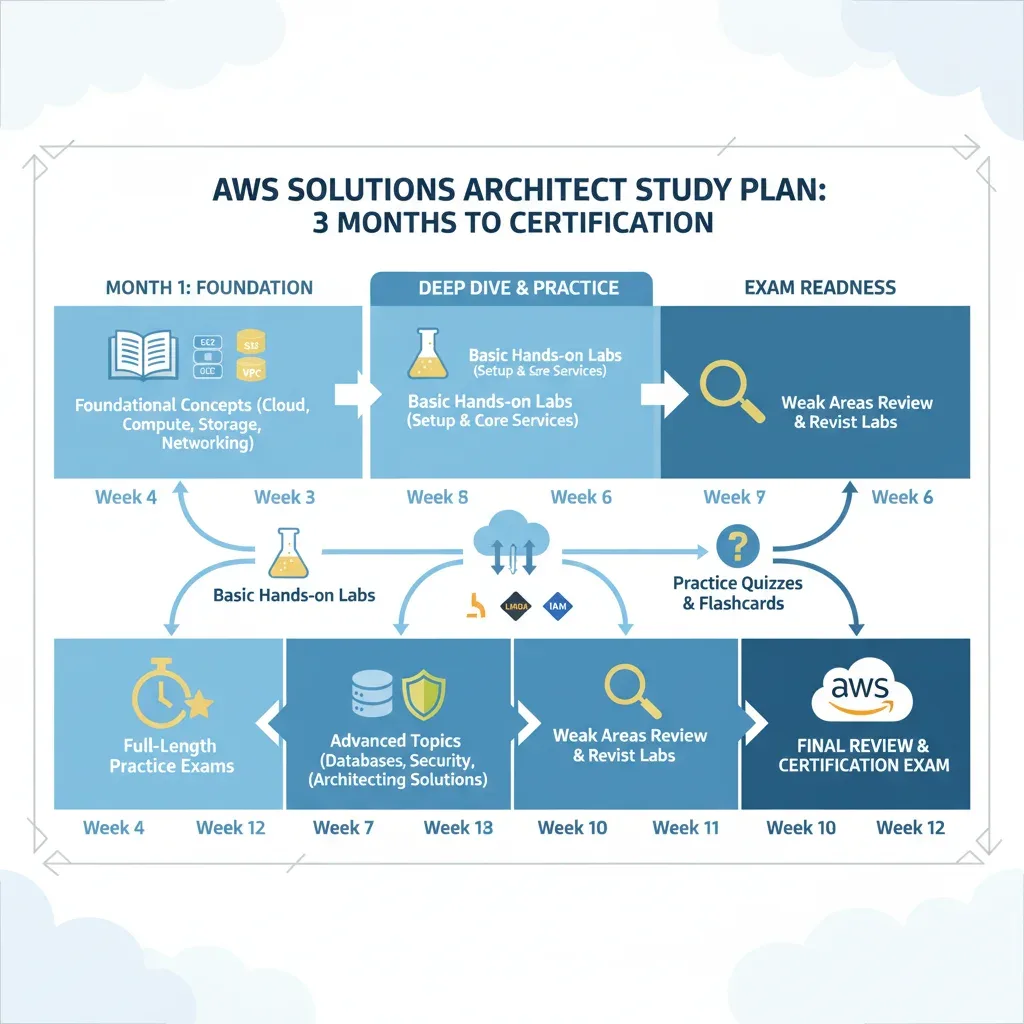
Phase 1: Foundational Concepts and Core Services (Month 1)
The first month is dedicated to building a strong foundation. Focus on understanding the core AWS services that form the backbone of most cloud architectures. This includes compute, storage, networking, and fundamental security principles. Familiarize yourself with the AWS Management Console and basic CLI commands.
- Week 1-2: AWS Fundamentals: Introduction to AWS, IAM, EC2 (instances, AMIs, load balancing, Auto Scaling), S3 (buckets, lifecycle policies, storage classes).
- Week 3-4: Networking and Databases: VPC (subnets, route tables, NACLs, security groups), Route 53, RDS (different database engines, read replicas, multi-AZ deployments), DynamoDB.
During this phase, prioritize understanding what each service does and why it’s used in specific scenarios. Don’t just memorize; strive to grasp the underlying architectural decisions. Hands-on labs are vital here to solidify your understanding of how these services function in a real-world context.
Deep Dive into Key AWS Services and Architectures
Once you have a solid grasp of the fundamentals, the second month shifts to a deeper exploration of more advanced services and architectural patterns. This phase focuses on integrating services, understanding their interdependencies, and applying best practices for building resilient and cost-effective solutions. You’ll begin to think more like a solutions architect, considering trade-offs and design choices.
This stage is where you start connecting the dots between individual services and how they collectively form a robust cloud solution. Pay close attention to scenario-based questions in practice exams, as they reflect the kind of problem-solving required for the certification. Understanding the nuances of each service, including its limitations and ideal use cases, becomes critical.
Phase 2: Advanced Services and Design Patterns (Month 2)
The second month is about expanding your knowledge to include more specialized services and architectural considerations. This will involve delving into serverless computing, analytics, and advanced security features. Understanding how different services interact and how to choose the right service for a particular workload is key.
- Week 5-6: Serverless and Analytics: Lambda, API Gateway, SQS, SNS, Kinesis, CloudWatch, CloudTrail, Athena, Glue.
- Week 7-8: Security, Management & Cost Optimization: KMS, WAF, Shield, Organizations, Billing and Cost Management, Trusted Advisor, CloudFormation.
Focus on understanding the Well-Architected Framework pillars: operational excellence, security, reliability, performance efficiency, and cost optimization. These pillars are central to the exam and good cloud architecture. Practice designing solutions that address these concerns, considering factors like data consistency, disaster recovery, and compliance. Engaging with case studies and example architectures can be extremely beneficial during this period.
Hands-On Practice and Practical Application
Theoretical knowledge alone is insufficient for passing the AWS Solutions Architect – Associate exam. Practical, hands-on experience is paramount. AWS is a platform built for doing, and the best way to understand its capabilities and intricacies is by actively building and deploying solutions. This hands-on component reinforces learning and helps you develop an intuitive understanding of how services interact.
Allocate dedicated time each week for labs and personal projects. Don’t just follow tutorials; try to implement solutions to real-world problems, even if they are simplified. This active learning approach will not only prepare you for the exam but also equip you with valuable skills for your future role as a solutions architect. Experimentation and troubleshooting are key parts of the learning process.
Leveraging AWS Free Tier and Lab Environments
The AWS Free Tier is an invaluable resource for gaining practical experience without incurring significant costs. Utilize it to set up EC2 instances, S3 buckets, RDS databases, and explore other services. Many online learning platforms also offer guided labs that simulate real-world scenarios, providing structured exercises to build your practical skills.
- Qwiklabs/Cloud Academy: Platforms offering guided, scenario-based labs.
- Personal Projects: Build a simple web application, deploy a static website, or set up a small data pipeline.
- AWS Documentation: Follow tutorials and examples provided in the official AWS documentation.
Focus on tasks like deploying a multi-tier application, configuring a VPC with public and private subnets, setting up a highly available database, and implementing various security controls. The more you build and break (and fix!), the deeper your understanding will become. This practical exposure will be critical for answering the scenario-based questions on the exam.
Exam Preparation and Mock Tests
As you enter the final month of your fast track, the focus shifts heavily towards exam preparation. This involves reviewing all covered topics, identifying knowledge gaps, and, most importantly, taking numerous practice exams. Mock tests are crucial for familiarizing yourself with the exam format, question types, and time management strategies. They help build confidence and reduce anxiety on exam day.
Don’t just take practice exams; analyze your results thoroughly. Understand why you got certain questions wrong and revisit the relevant AWS documentation or course material. This iterative process of testing, reviewing, and re-learning is highly effective for solidifying your knowledge and improving your score.
Phase 3: Review and Practice Exams (Month 3)
The final month is dedicated to consolidating your knowledge and honing your exam-taking skills. This phase should involve a comprehensive review of all domains, focusing on areas where you feel less confident. The goal is to ensure you have a well-rounded understanding of all topics covered in the exam blueprint.
- Week 9-10: Comprehensive Review: Revisit all services, architectural best practices, and the Well-Architected Framework. Pay special attention to security, cost optimization, and troubleshooting scenarios.
- Week 11-12: Practice Exams and Final Polish: Take multiple full-length practice exams. Simulate exam conditions as closely as possible. Review all questions, both correct and incorrect, to understand the rationale behind the answers.
Utilize resources like AWS official practice exams, reputable third-party practice tests, and study guides. Focus on understanding the subtle differences between similar services and when to choose one over another. Time management during the exam is also critical, so practice pacing yourself to ensure you complete all questions within the allotted time.
Maintaining Motivation and Overcoming Challenges
Embarking on a 3-month fast track for a certification like the AWS Solutions Architect requires significant discipline and mental fortitude. It’s common to encounter moments of doubt or feel overwhelmed by the sheer volume of information. Maintaining motivation and developing strategies to overcome challenges are as important as the study plan itself. Remember why you started this journey and the career opportunities it will unlock.
Break down your study sessions into smaller, manageable chunks to prevent burnout. Celebrate small victories along the way, like mastering a difficult concept or successfully completing a complex lab. Connecting with a study group or online community can also provide valuable support, allowing you to share insights and troubleshoot problems together.
Strategies for Success and Avoiding Burnout
To stay on track and prevent burnout, integrate self-care into your study routine. Adequate rest, healthy eating, and regular exercise are crucial for cognitive function and overall well-being. A fresh mind is far more effective at absorbing and retaining information.
- Set Realistic Daily Goals: Avoid overly ambitious schedules that lead to frustration.
- Take Regular Breaks: Step away from your studies to recharge.
- Reward Yourself: Acknowledge your progress with small rewards.
- Seek Support: Connect with peers or mentors for encouragement and advice.
Remember that challenges are a natural part of any intensive learning process. Don’t be discouraged by difficult topics or low scores on initial practice tests. View them as opportunities for growth and targeted learning. Your perseverance during these challenging moments will ultimately lead to your success in earning the AWS Solutions Architect certification.
Beyond Certification: What’s Next?
Earning your AWS Solutions Architect – Associate certification by June 2026 is a significant milestone, but it’s also just the beginning of your cloud journey. The cloud landscape is constantly evolving, with new services and features being released regularly. Continuous learning is essential to stay relevant and advance further in your career.
This certification provides a strong foundation, but real-world experience is invaluable. Look for opportunities to apply your newly acquired skills in projects, whether at your current job, through freelance work, or by contributing to open-source initiatives. The more you build and solve problems on AWS, the more proficient and confident you will become.
Continuous Learning and Career Growth
The cloud industry offers numerous paths for specialization and advancement. Consider exploring advanced AWS certifications or delving into specific domains like security, machine learning, or data analytics. Networking with other cloud professionals and staying updated with industry trends will also be crucial for long-term success.
- Advanced Certifications: AWS Certified Solutions Architect – Professional, Specialty Certifications.
- Specialized Roles: Cloud Security Engineer, DevOps Engineer, Data Engineer.
- Community Engagement: Attend webinars, conferences, and join online forums.
- Mentorship: Seek out mentors or become one to foster continuous growth.
Your AWS Solutions Architect certification is a powerful credential that validates your expertise and opens doors. However, true mastery comes from continuous learning, practical application, and a commitment to staying current with the ever-evolving world of cloud computing. Embrace this journey as an ongoing process of discovery and innovation.
| Key Aspect | Brief Description |
|---|---|
| Structured Study Plan | Divide 3 months into phases: fundamentals, advanced services, and exam prep, with clear weekly goals. |
| Hands-On Practice | Utilize AWS Free Tier and labs to build and deploy solutions, reinforcing theoretical knowledge. |
| Extensive Mock Tests | Regularly take practice exams to identify gaps, manage time, and build confidence for the actual test. |
| Continuous Learning | Post-certification, commit to ongoing education and practical application to stay current in cloud tech. |
Frequently Asked Questions About AWS Certification
Is a 3-month timeline realistic for the AWS Solutions Architect Associate certification?▼Yes, a 3-month timeline is realistic for the AWS Solutions Architect Associate certification, provided you dedicate consistent effort and follow a structured study plan. It requires several hours of study and hands-on practice each week, but many successful candidates have achieved it within this timeframe.
What are the best resources for studying for this certification?▼Top resources include official AWS documentation, online courses from platforms like A Cloud Guru or Udemy, practice exams from reputable providers (e.g., Jon Bonso), and hands-on labs using the AWS Free Tier. Combining these resources offers a comprehensive learning experience.
How much hands-on experience is necessary?▼Significant hands-on experience is crucial. The exam includes scenario-based questions that test your practical understanding of how AWS services work together. Aim for at least 15-20 hours of hands-on lab work throughout your 3-month study period to solidify concepts.
What is the cost associated with the AWS Solutions Architect certification?▼The exam fee for the AWS Certified Solutions Architect – Associate is $150 USD. Additionally, you might incur costs for online courses, practice exams, and potentially some AWS usage beyond the Free Tier. Budgeting for these expenses is part of your preparation.
What career opportunities open up after earning this certification?▼This certification opens doors to roles such as Cloud Solutions Architect, Cloud Engineer, Cloud Consultant, and DevOps Engineer. It significantly enhances your employability and earning potential in organizations adopting or already leveraging AWS cloud services for their operations.
Conclusion
Embarking on the 3-month fast track to earn your AWS Solutions Architect Certification by June 2026 is an ambitious yet highly achievable goal. With a disciplined approach, a well-structured study plan, and a commitment to both theoretical learning and extensive hands-on practice, you can successfully master the complexities of AWS architecture. This certification not only validates your expertise but also serves as a powerful catalyst for career advancement and increased earning potential in the ever-expanding world of cloud computing. Your dedication now will undoubtedly pave the way for a rewarding future in cloud architecture.